
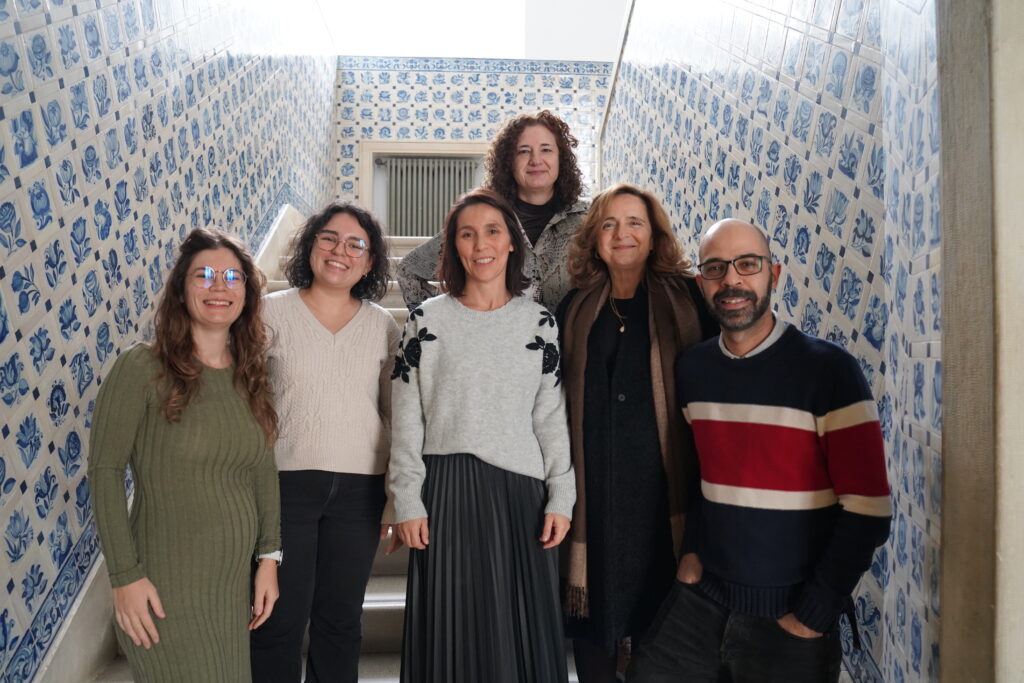
From left to right: Fernanda Garcia, Irene Marques, Joana Alves, Paula Castro (up), Prof. Helena Freitas (Coord.) and Miguel Moreira
The team from the Centre for Functional Ecology – Science for People & the Planet (CFE), is integrated on the Department of Life Sciences of the University of Coimbra (Portugal) and is coordinated by Prof. Helena Freitas.
The CFE team participates in this project by providing expertise that combines advanced Geographic Information Systems (GIS) analysis and participatory action research (PAR), with extensive experience in landscape ecology, ecological dynamics, biodiversity conservation, ecosystem services, climate change and sustainable ecosystem management. In particular, the team members are part of the “BeWild Lab” (BeWild Lab), a research laboratory dedicated to advancing the fields of Behavioural Ecology and Wildlife Conservation, and from the Forum for Agroecological Studies and Transitions (FAST), a CFE’s multidisciplinary research group which aims to delve into the adoption of agroecological principles and practices within agri-food systems, charting a course towards ecosystem restoration, enhanced social welfare, and sustainable food systems from production to consumption.
In the Europe-LAND project, the CFE team manages the case-study of Castro Verde Biosphere Reserve (BR) (RB de Castro Verde) in southern Alentejo region, Portugal. The study area’s landscape strongly features arable dry-cereal crops in rotation with fallow land and vast grasslands with livestock, permanently populated with steppe birds, being part of the traditional and historical image of the Southern Alentejo region. The Castro Verde land-use corresponds mostly to extensive cereal crops and grasslands (86%), which is essential for preserving biodiversity and promoting sustainable management practices. Castro Verde region is largely classified as Special Protection Area (SPA), designated under the European Union’s Birds Directive (Natura 2000 Network), corresponding to 85% of the entire study area, being of critical importance for the conservation and survival of steppe birds with unfavourable conservation status. The significance of this area was also recognised by Birdlife International (PT029), which classified the SPA of Castro Verde territory as crucial for the conservation of bird populations and the habitats that sustain them on a global scale. In 2017, this territory has been designated as a UNESCO Biosphere Reserve, a classification that underscores the region’s commitment to balancing conservation with sustainable land use and development. Therefore, Castro Verde has been a pilot area to test tools, methods, and techniques to combat desertification and to promote climate change adaptation and mitigation of negative impacts on steppe biodiversity.
You can find more information about CFE’s research and current projects here: Centre for Functional Ecology: Science for People & Planet