
A Europe-wide expert survey shows that while climate change and market pressures affect forests across the continent, governance capacity ultimately determines how forests respond to these challenges.
European forests are changing, but not everywhere in the same way. In his recent study, Krumins et al. (2026) show how forest experts across all 27 EU Member States perceive ongoing forest change. The research is based on a structured survey of 508 forest experts representing all EU Member States. Participants assessed the dominant types of forest change, their spatial distribution, the main environmental and socio-economic drivers, and the governance structures shaping forest management. The analysis follows a PESTEL framework – examining changes in Political, Economic, Social, Technological, Environmental and Legal influences on forest change across Europe.
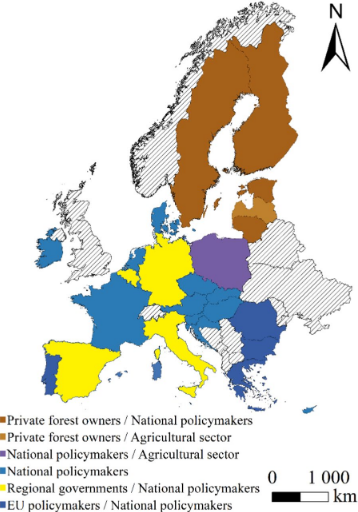
The results show pronounced regional differences. Afforestation, reforestation and natural forest regrowth are the dominant trends in Northern Europe and parts of Central Europe. In contrast, Southern and Eastern Europe are experiencing increasing forest degradation, climate-related disturbances such as droughts and wildfires, and stronger pressures from deforestation and land-use change. Across many regions, urban expansion and infrastructure development are also driving forest fragmentation.
Other findings reveal that policy coherence, effective enforcement, institutional coordination and regionally adapted incentives are decisive factors influencing forest resilience. National policymakers and the agricultural sector were considered the most influential actors, while stakeholder conflicts over land use were reported across all European regions (see figure 1). These findings demonstrate that forest change cannot be understood solely through ecological indicators or remote sensing data; institutional and governance contexts are equally important.
For EuropeLAND, the study underlines the value of integrating governance perspectives into land-use research. Sustainable forest management requires more than monitoring changes in forest cover—it demands an understanding of the social, economic and political processes that shape landscapes over time. By combining expert knowledge with spatial analyses and policy perspectives, the research offers an important contribution to developing regionally adapted strategies that strengthen forest resilience, biodiversity conservation and climate adaptation across Europe.
The findings reinforce EuropeLAND’s commitment to supporting evidence-based land governance that reflects both environmental dynamics and institutional realities. By combining perspectives from researchers, policymakers and practitioners, the study highlights that ecological trends are closely linked to governance systems, policy implementation and regional management capacities—offering valuable insights for sustainable land governance and the objectives of the EuropeLAND project.
Read the full publication: Krumins, J., Klavins, M., Sima, M. et al. Forest change across the European Union: spatial patterns, drivers, and governance insights from a pan-European expert survey. Annals of Forest Science 83, 17 (2026). https://doi.org/10.1186/s13595-026-01335-9
Want to learn more? Explore our previous article on how structural imbalances in European forest research may influence the effectiveness of forest-related policy and governance.