
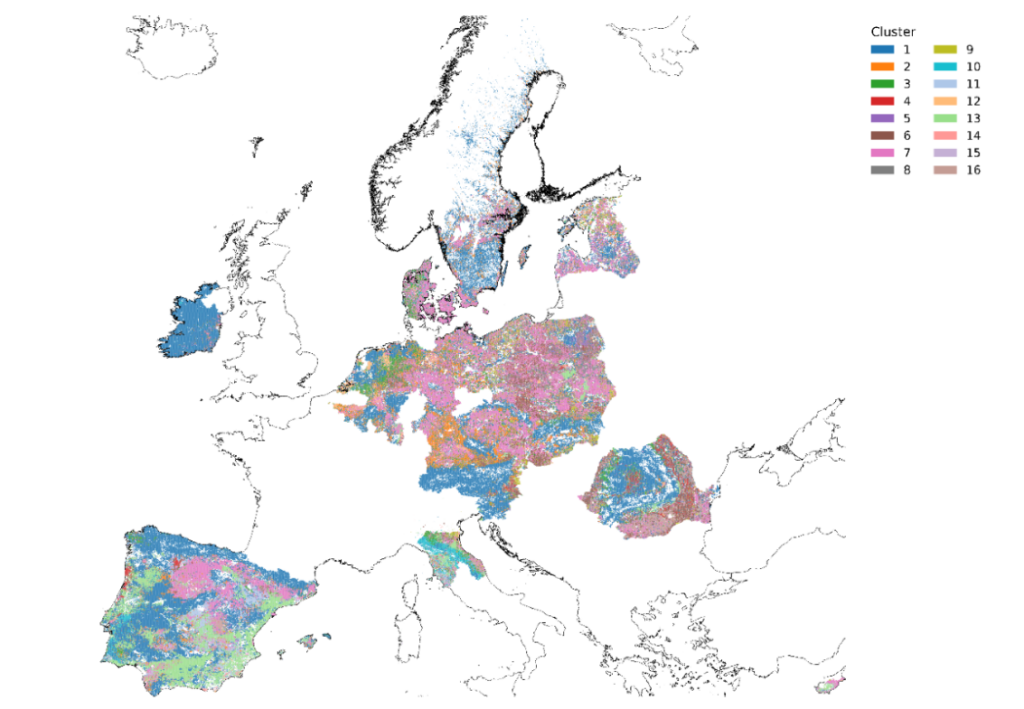
The Europe-LAND project has released a new deliverable presenting a Europe-wide farm typology framework developed from harmonized agricultural land-use data. Using field- and farm-level information from the Integrated Administration and Control System (IACS), the study demonstrates how harmonized datasets can be used to identify common farming patterns across diverse agricultural regions in Europe.
The analysis draws on data from more than 3.6 million farms covering nearly 90 million hectares of farmland across 18 EU Member States. By aggregating detailed crop declarations into harmonized crop groups and applying advanced clustering methods, researchers identified 16 distinct farm typologies representing a wide range of production systems, from permanent grassland and livestock-oriented systems to specialized cereal, maize, horticultural, and permanent crop farms.
Beyond differences in crop composition, the typologies also capture variation in farm structure, including farm size and field configuration. Mapping the resulting typologies revealed clear regional patterns across Europe, with certain production systems strongly concentrated in specific agricultural regions while others are more widely distributed.
The study highlights the growing potential of harmonized IACS datasets for analyzing agricultural systems at the European scale. While differences in national reporting systems and crop classifications remain an important challenge, the results demonstrate that meaningful cross-country farm typologies can be developed from harmonized data, providing new opportunities for agricultural monitoring, land-use research, and policy analysis.
The publication represents an important step towards improving our understanding of farming diversity across Europe and showcases how Europe-LAND’s harmonized agricultural database can support large-scale analyses of agricultural land use and farm structures.
The full report, Publication of Farm Typologies Across the EU, is available on the Europe-LAND Zenodo, as well as our website results section.
To learn more about this deliverable, join us for our upcoming Webinar #13 on 8 June.