
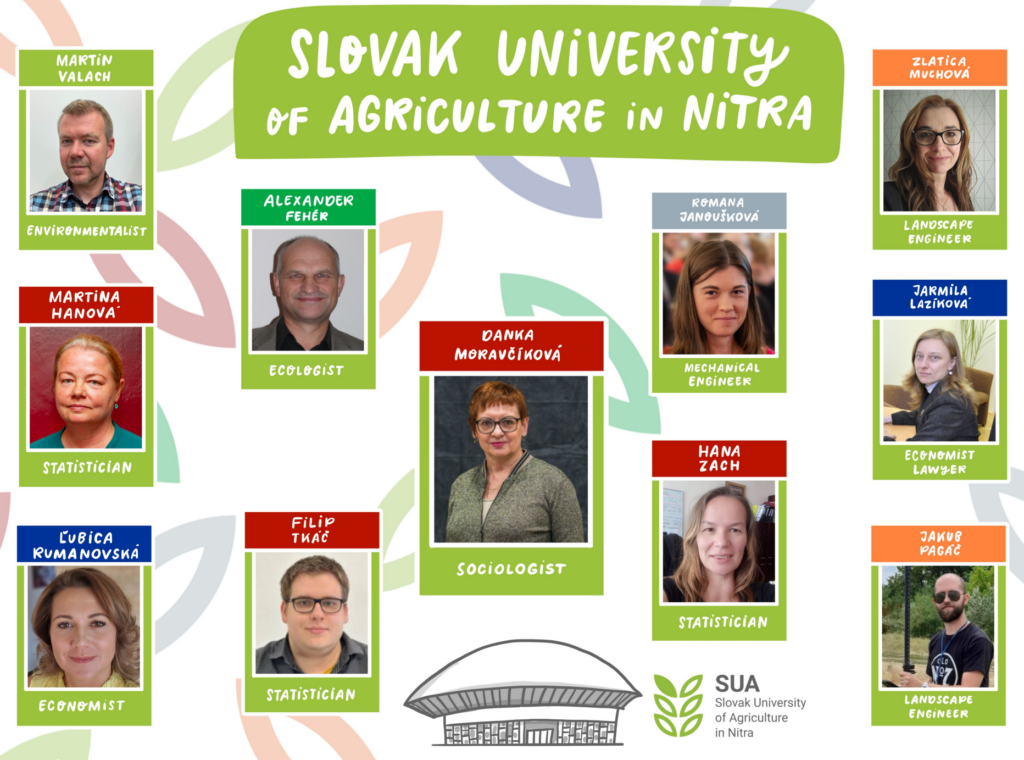
The Slovak University of Agriculture in Nitra (SUA) team in the Europe-LAND project has brought together experts in social and natural sciences from five university faculties. The interdisciplinary SUA team is leading WP5 that synthesizes all qualitative and quantitative data. The final result will be a proposal and design of a new telecoupling model framework that will enable various stakeholders to simulate, in both spatial and temporal terms, how their planned measures and decisions may affect current and future land use.
Danka Moravčíková is leading the project team and is an associate professor at the Institute of Marketing, Trade and Social Studies at the Faculty of Economics and Management. She also leads the Section of Rural Sociology and Sociology of Agriculture of the Slovak Sociological Society at the Slovak Academy of Sciences. Her research is focused on specific groups of rural and agricultural population, farming intentions, innovations in the agri-food sector in the sustainable development context, and on the social aspects of climate change adaptation using qualitative methods, participatory methods and actor-oriented approaches.
Jarmila Lazíková is a professor of economics and management at the Institute of Law at the Faculty of European Studies and Regional Development. She obtained a PhD in sectoral and cross-sectional economics, and a PhD in international and European law. Her research focusses on European law, with a focus on intellectual property, agrarian, and land law. Her publications focus mainly on the economic and legal aspects of the agricultural land market, land ownership and land use relations, and the protection of agricultural land. She is a member of the World Union of Agricultural Law.
Zlatica Muchová is a professor at the Institute of Landscape Engineering at the Faculty of Horticulture and Landscape Engineering. Her scientific and research activities focus on optimising land consolidation processes and the spatial arrangement of landscapes for reasonable planning agendas, using geographic information systems in landscape engineering. In the Europe-LAND project, she specialises, particularly, in spatial data analysis and mining of environmental geospatial information.
Professor Alexander Fehér works at the Institute of Crop Production of the Faculty of Agrobiology and Food Resources. His research is mainly focused on biodiversity, ecology of agricultural landscapes, traditional ecological knowledge, and ecosystem services. He has completed short-term and long-term internships in Europe, Asia, Africa, South and North America, where he also dealt with tropical and subtropical botany and ecosystems. He is currently the Vice-Chairman of the West Slovak Branch of the Slovak Botanical Society at the Slovak Academy of Sciences.
Ľubica Rumanovská is an associate professor and head of the Department of European Policies and Public Administration at the Faculty of European Studies and Regional Development. Her research addresses the economic impacts of ownership and land use relations on sustainable land management, reflecting a nuanced understanding of how institutional and regulatory frameworks shape land management practices and outcomes. Her activities encompass also European policies, agricultural land use, and the adoption of innovative and sustainable practices in agriculture.
Martina Hanová is an assistant professor at the Institute of Statistics, Operations Research and Mathematics at the Faculty of Economics and Management. Her research work focusses on the application of multi-criteria decision-making methods and quantitative modelling, particularly in the context of agricultural policy, sustainable consumption, well-being, and food security. Her current research also focusses on modelling land use changes and assessing their impacts on society and the environment in line with sustainability challenges.
Jakub Pagáč is a scientific researcher at the AgroBioTech Research Centre. His research focusses on increasing biodiversity in the landscape, soil degradation (particularly water erosion), land ownership relationships, land consolidation, land size, identification of critical land profiles in the landscape, field mapping, and land use optimization. He also works extensively with GIS and CAD environments.
Hana Zach coordinates sustainability and green issues at the SUA in Nitra and is based at the Office of Project and Transfer Activities. As part of her research background, she specializes in statistics and the application of quantitative methods. Her role in the Europe-LAND project aims at constructing and testing a conceptual telecoupling framework to analyze land-use strategies by synthesizing quantitative and qualitative evidence and relevant integrated assessment modelling approaches.
Filip Tkáč is a university lecturer at the University Counselling and Support Centre. In his teaching, publishing, and professional activities, he focusses on issues related to the organization of education, its legislative framework, as well as the application of sustainability principles and the implementation of ESG principles. He has expertise in e-learning, the creation of educational platforms and modern digital approaches.
Romana Janoušková has a PhD from the Faculty of Engineering, where she researched the degradation of ecological energy carriers and their impact on the flow characteristics of hydraulic pumps. She now works in the Office of the Internal Quality Assurance System, focusing on applying quality assurance standards in the European Higher Education Area. Within the Europe-LAND project, she provides expert support in the completion and categorization of quantitative data.
Martin Valach has an PhD in environmental science and over ten years of professional experience in the administration and coordination of international scientific projects. As an employee of the Office of Project and Transfer Activities at SUA, he has successfully managed projects under Horizon 2020, Horizon Europe, Interreg Europe, and other EU programs. He combines his scientific expertise with strong project management skills to support research teams in achieving their goals effectively.