
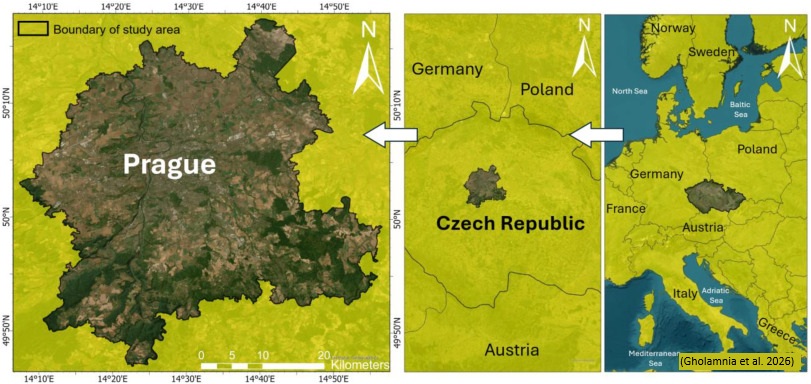
How might land-use changes affect future carbon storage in metropolitan regions? A new study focusing on the Prague Metropolitan Area combines machine learning, spatial modelling and the InVEST model to explore alternative development scenarios through 2050. The findings highlight how urbanisation, infrastructure and vegetation dynamics may shape future land use and carbon sequestration.
A new study by Khalil Gholamnia, Omid Ghorbanzadeh, Thomas Blaschke un Lucie Kupková explores how future land-use and land-cover change (LUCC) could shape carbon sequestration in the Prague Metropolitan Area. Published in Environmental and Sustainability Indicators, the study combines machine learning, spatial land-use modelling and ecosystem-service assessment to examine alternative development pathways through 2050.
The authors developed an integrated framework combining Random Forest (RF) machine learning, CA–Markov spatial simulation, SHAP-based interpretation and the InVEST Carbon Storage and Sequestration model. Using land-cover data from 2018, 2021 and 2024, the framework identifies the drivers of land-use transitions and projects future landscape patterns under three scenarios: Business-as-Usual (BAU), Urban Growth (UGS) and Ecological Optimization (EOS). The scenarios are designed as exploratory pathways rather than deterministic forecasts.
The analysis highlights the importance of accessibility and infrastructure in shaping land-use change. Anthropogenic accessibility factors accounted for most of the cumulative feature importance in six of the seven analysed land-cover classes. For built-up areas in particular, distance to roads was identified as the most important individual predictor, while environmental variables such as elevation and temperature played a stronger role for hydrologically sensitive classes such as flooded vegetation.
The scenario simulations further illustrate how different land-use pathways can lead to contrasting landscape and carbon outcomes. Under the BAU scenario, forest expansion partly offsets carbon losses associated with urban growth. The EOS scenario results in the largest forest extent and the highest carbon sequestration potential, while the UGS scenario produces the strongest urban expansion and the greatest decline in cropland. Across the scenarios, forests remain the dominant carbon sink, whereas cropland conversion and urban expansion are key drivers of carbon redistribution.
By bringing together land-use modelling, explainable machine learning and carbon assessment, the study provides a spatially explicit framework for examining the links between landscape transformation and ecosystem carbon storage. The results underline the importance of considering not only the amount of land-use change, but also where changes occur in relation to existing carbon-rich landscapes and infrastructure networks.

Read the full publication: Gholamnia, K., Ghorbanzadeh, O., Blaschke, T., & Kupková, L. (2026b). Multi-scenario machine learning–driven LUCC simulation and InVEST-based carbon sequestration assessment: A case study of metropolitan Prague, Czech Republic. Environmental and Sustainability Indicators, 32, 101470. https://doi.org/10.1016/j.indic.2026.101470