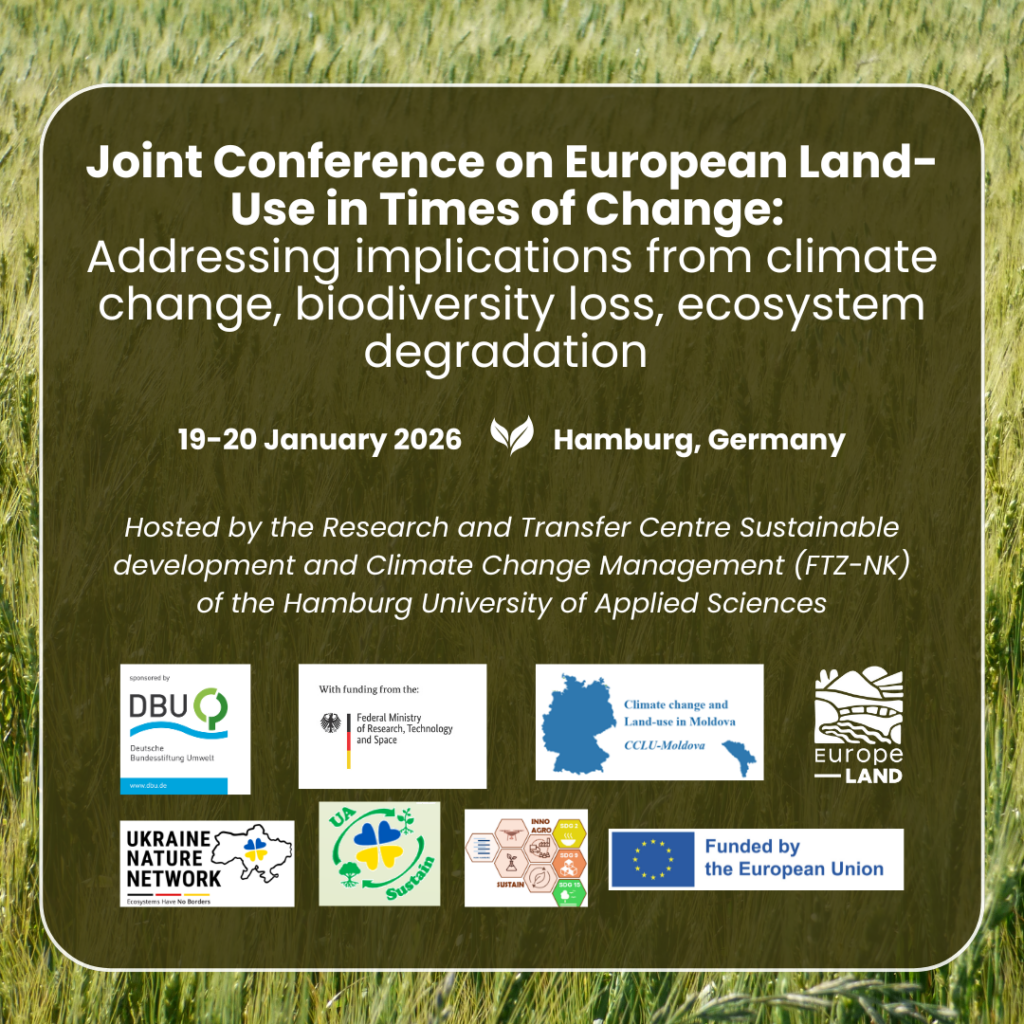
On 19–20 January, partners and stakeholders from across Europe met in Hamburg, Germany for a joint conference bringing together Europe-LAND, UA-Sustain, Ukraine Nature Network, CCLU-Moldova, and InnoAgroSustain. The two-day event centered on a shared challenge: how land use and land management can be made more sustainable in the face of climate change, biodiversity loss, and competing stakeholder interests.
Day One
The conference opened with a welcome message by Europe-LAND Coordinator Franziska Wolf (HAW Hamburg, Germany), who encouraged participants joining both in person and online to make the most of this opportunity for cross-project exchange and collaboration.
Maria Fedoruk (HAW Hamburg, Germany) and Viktoriia Khrutba (Eberswalde University for Sustainable Development, Germany) presented work from the Ukraine Nature Network, highlighting that Ukraine accounts for approximately 19% of Europe’s agricultural land, while over 20% of its protected areas have been affected by war. They outlined a two-phase approach combining the assessment of war-related environmental damage with the development of site-specific restoration measures, emphasising the importance of long-term sustainability and responsibility towards future generations.
Joining virtually, Danka Moravčíková (Slovak University of Agriculture in Nitra, Slovakia) presented the work of the Slovak EIT Food Hub, highlighting how collaboration and innovation can support resilient and climate-neutral food systems. Her contribution sparked discussion on the interlinkages between food security, land use, and environmental protection across Europe.
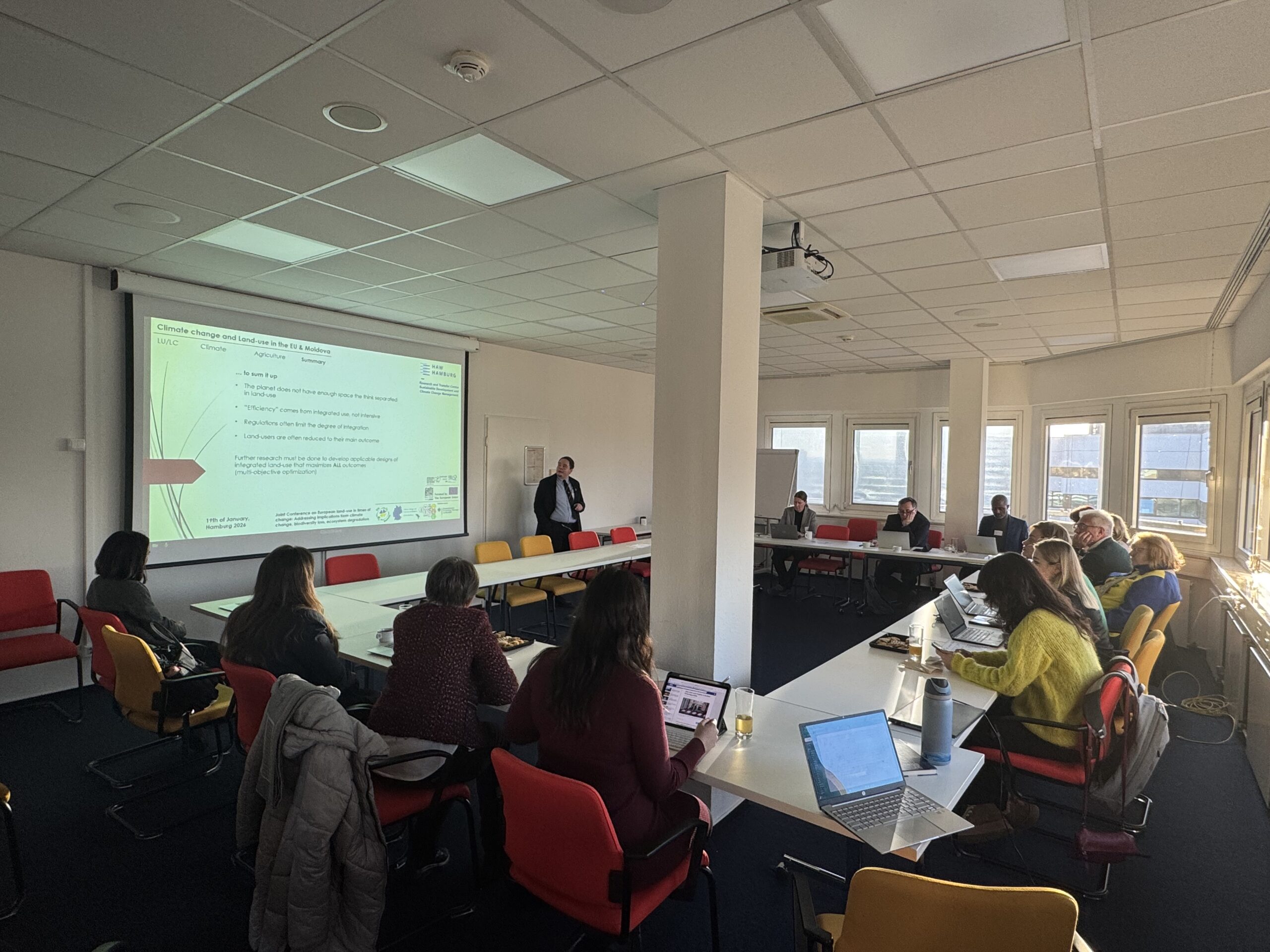
Sven Kannenberg (HAW Hamburg, Germany) addressed integrated land-use approaches across the EU, with a focus on Moldova, where rising temperatures and increasing drought are placing pressure on water management. Complementing this perspective, Joanna Godlewska (Bialystok University of Technology, Poland) introduced an upcoming Europe-LAND report outlining a structured framework for assessing regulatory instruments influencing land-use decisions.
The day concluded with insights from Silvia Suvac (Ion Creangă State Pedagogical University, Moldova) on Moldovan–German research cooperation, including the publication of a guide on Climate Change Adaptation and Sustainable Land Use in the Republic of Moldova.

Day Two
The second day focused on tools, knowledge exchange, and project synergies. An overview of the Ukrainian National Forestry University by Professors Ihor Soloviy and Lyudmyla Zahvoyska (Ukraine) highlighted the institution’s growing engagement in EU-funded initiatives, including CircHive, ForestPost, and several Erasmus+ projects.
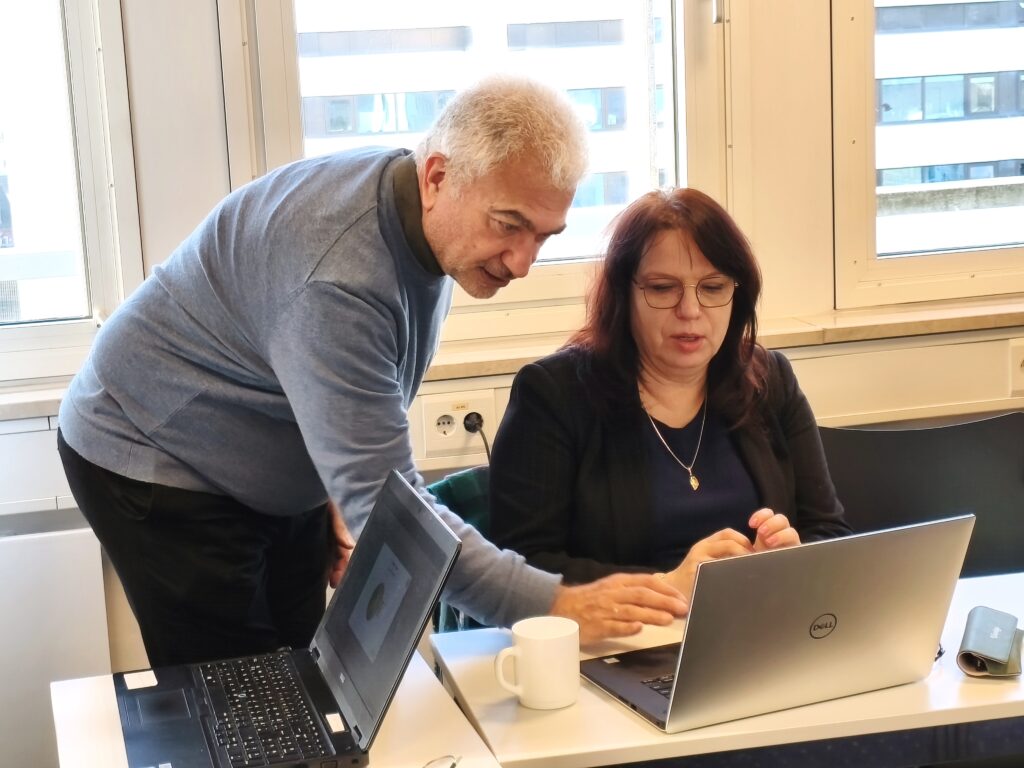
Nikolaos Theodosiou (Aristotle University of Thessaloniki, Greece) led participants exploration of the platform’s core functionalities and provided feedback, underscoring Europe-LAND’s commitment to co-developing practical digital tools that support transparent, data-driven land-use decision-making.
The end of the event also served as the final conference of the Inno Agro Sustain project and kick-off session of the UA-Sustain project, further emphasizing the strong collaboration in the European land-use research field.
Overall, the joint conference underlined the importance of integrated, evidence-based, and collaborative approaches to sustainable land use that Europe-LAND is committed to. Existing connections were strengthened, new collaborations emerged, and participants left Hamburg with renewed momentum to continue this important work.